

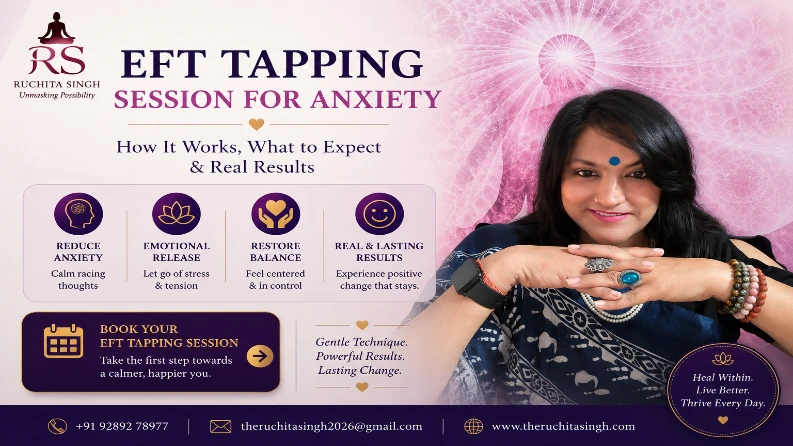
If you have read about EFT tapping but are not sure whether a dedicated EFT tapping session for anxiety would actually help you — you are asking the right question. Understanding what EFT is in theory is very different from experiencing what it does to anxiety in practice.
This guide is written specifically for that second part: what an EFT tapping session for anxiety involves, what the experience is actually like from beginning to end, what the research says about why it works on anxiety specifically, how it compares to therapy and medication, and what to expect in terms of results and timeline.
Note: If you are here to understand the foundational explanation of what EFT tapping course online is, we have a separate guide that covers that — linked below. This guide assumes you already know the basics and are trying to decide whether an EFT session for anxiety specifically is worth trying.
Why EFT Works Specifically on Anxiety — The Physiology
Most anxiety treatments work on the cognitive level — they ask you to think differently about the things that make you anxious. Cognitive behavioural therapy, journaling, positive affirmations — these are all approaches that engage the cortex, the brain’s thinking and reasoning centre.
The problem is that anxiety does not live in the cortex. It lives in the amygdala — the brain’s threat-detection and alarm system — and in the body’s autonomic nervous system, which operates below conscious thought. This is why thinking your way through anxiety has limited effectiveness: you are applying a cortex-level solution to a subcortical problem.
Emotional freedom technique therapy works differently. The physical act of tapping on specific acupoints — points that correspond to meridian endpoints in Traditional Chinese Medicine — sends a signal directly to the amygdala that overrides the alarm response. Clinical research has shown that EFT tapping measurably reduces cortisol (the primary stress hormone) by an average of 43% — a result that talk therapy and cognitive interventions do not produce at the same rate or speed.
The combination of tapping these points while verbalising the anxiety-provoking thought allows the brain to process the threatening stimulus without the normal fear response — essentially teaching the amygdala that the stimulus is not dangerous. Over repeated sessions, this reprogramming builds and persists.
What Happens During an EFT Tapping Session for Anxiety With Ruchita Singh
A full EFT tapping session for anxiety with Ruchita Singh typically runs 60 minutes. Here is what the session looks like from start to finish:
- Identifying the Target
The session begins by identifying what specifically is driving the anxiety. Anxiety is rarely about a single thing, and EFT works most effectively when it addresses specific memories, events, situations, or physical sensations rather than ‘anxiety’ as a general category. Ruchita works with you to identify the specific triggers — the images, words, memories, or body sensations — that are most active.
- The Setup Statement
Before tapping begins, you establish a Setup Statement — a phrase that acknowledges the problem honestly while introducing the possibility of acceptance. A typical Setup Statement for anxiety sounds like: ‘Even though I feel this tightness in my chest every time I think about [specific situation], I completely and deeply accept myself.’ This statement is repeated three times while tapping the karate chop point on the side of the hand.
This step is important because it prevents the brain from resisting the process. Anxiety is often linked to self-criticism and judgement; the acceptance phrase introduces a pattern interrupt.
- The Tapping Sequence
The main tapping sequence moves through 8 points, each tapped approximately 7 times while repeating a reminder phrase that keeps the target in focus:
- Top of the head: Crown point — governs overall nervous system regulation.
- Eyebrow: Beginning of the eyebrow, above the nose — associated with trauma and sadness.
- Side of eye: On the bone at the outer corner of the eye — associated with fear and resistance.
- Under the eye: On the bone below the pupil — associated with anxiety and worry.
- Under the nose: The philtrum — associated with shame and self-blame.
- Chin: Below the lower lip — associated with confusion and uncertainty.
- Collarbone: Just below the collarbone, to the side of the breastbone — associated with general stress and anxiety.
- Under the arm: About 10cm below the armpit — associated with self-worth issues that underlie many anxiety patterns.
The sequence is repeated multiple times, with the verbal content adapting as your experience shifts — moving from the initial statement of the problem toward increasing acceptance, safety, and resolution.
- Checking In and Tracking the SUDS Level
Throughout the session, Ruchita periodically checks your SUDS level — Subjective Units of Distress Scale, a simple 0–10 self-rating of how intensely you are experiencing the anxiety. The goal is to bring the SUDS level from wherever it started (often 7–9 for significant anxiety) down to 2 or below — the point at which the memory or trigger no longer produces a significant fear response.
EFT Tapping vs Therapy and Medication for Anxiety — What Is Different?
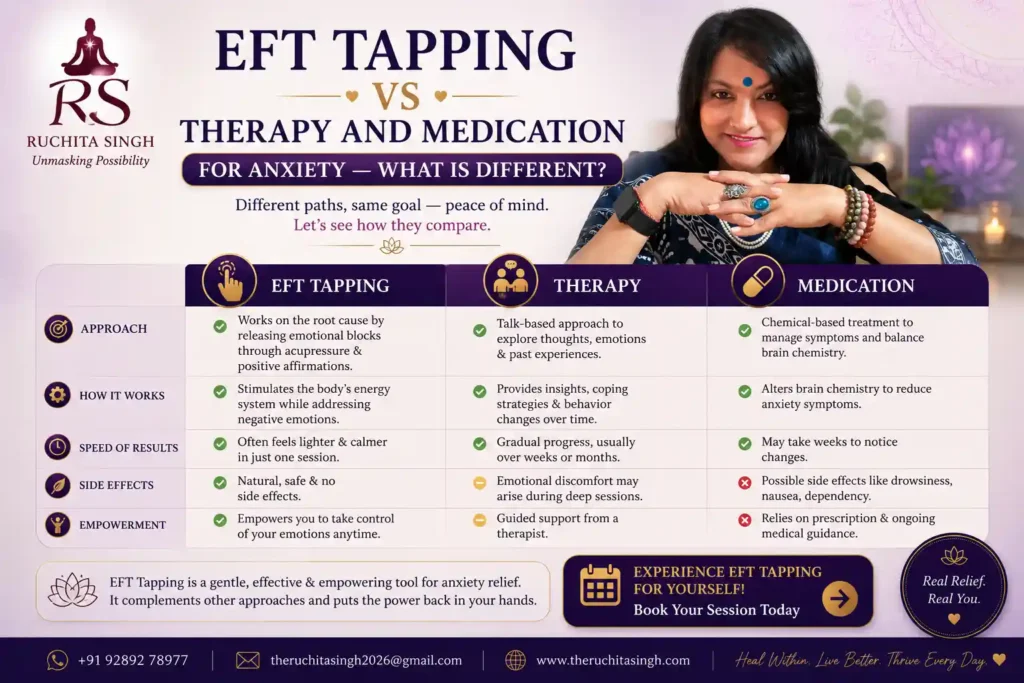
This is a question many people ask — especially those who have tried therapy or medication and are looking for something different, or those who are hesitant about medication and wondering if EFT is a viable alternative.
- EFT vs Cognitive Behavioural Therapy (CBT): CBT targets the thought patterns around anxiety. EFT targets the physiological response in the body and amygdala directly. Many people find EFT produces faster physical results, while CBT produces stronger cognitive restructuring. They are often used effectively together.
- EFT vs Medication: Medication addresses anxiety through neurochemistry — changing the baseline levels of serotonin, GABA, or cortisol. EFT addresses the specific triggers and memories that activate the anxiety response. Medication can reduce overall anxiety levels; EFT can clear the specific roots. Neither fully replaces the other for severe anxiety, but for mild-to-moderate anxiety, EFT alone produces clinically meaningful results.
- EFT vs General Mindfulness/Meditation: Mindfulness helps you observe anxiety without reacting to it. EFT aims to reduce the emotional charge of specific anxiety triggers so that the trigger no longer produces the anxiety response at all — not just observing it, but desensitising it.
How Many EFT Sessions for Anxiety Do You Need?
One of EFT’s notable characteristics as a therapy is its relative speed compared to talk therapy. Where CBT or psychotherapy might require 20–30 sessions to address a specific anxiety, EFT tapping therapy often produces significant results in 3–10 sessions — sometimes less for situational anxiety, sometimes more for complex or long-standing patterns.
Here is a realistic guide:
- Situational anxiety (exam, presentation, specific event): 2–4 sessions can significantly reduce the anxiety response around the specific trigger.
- Generalised anxiety with identifiable triggers: 6–8 sessions, working through the most significant triggers one by one.
- Anxiety with roots in past trauma or long-standing patterns: 10–15+ sessions in most cases. This is not a limitation of EFT — it is the nature of the work involved.
Self-tapping between sessions — using the techniques from the session independently — significantly accelerates the process and is actively encouraged in Ruchita Singh’s EFT practice.
What Ruchita Singh's EFT Sessions Look Like in Practice
Ruchita Singh is a certified EFT practitioner offering sessions online across India by phone and video call. Her approach to EFT tapping classes online for anxiety integrates the clinical EFT protocol with her broader background in holistic healing, tarot, and energy work.
This means that sessions are never purely mechanical. The tapping protocol is the core of each session, but Ruchita’s ability to identify the specific emotional roots of the anxiety — often things a client has not consciously connected to their anxiety — reflects her wider experience working with the energy and emotional body.
Sessions are conducted in a space of complete confidentiality. Nothing shared in a session is repeated or discussed outside it. For many people who have struggled with anxiety in silence, this privacy is a significant part of what makes the work possible.
Is an EFT Tapping Session for Anxiety Right for You?
If your anxiety has specific triggers — situations, memories, relationships, fears — that you can identify, EFT is likely to be directly useful. If your anxiety feels more diffuse and you are not sure what drives it, a session is still valuable — part of what a skilled practitioner does is help you locate the specific roots that are driving the general state.
The best way to know if EFT will work for your anxiety is to try a single session. The physiological shift that tapping produces is something most people can feel clearly during the session itself — not a placebo effect that requires belief, but a measurable change in how your body is holding the anxiety.
Frequently Asked Questions
Can EFT tapping be done on your own at home for anxiety?
Yes. Self-tapping is a core part of the EFT approach, and Ruchita Singh teaches clients to use the tapping protocol independently between sessions. For mild and situational anxiety, self-tapping with basic guidance can be highly effective. For complex or trauma-rooted anxiety, working with a trained practitioner significantly deepens the results compared to self-practice alone.
Is EFT tapping evidence-based, and is it recognised in India?
Yes. EFT has a substantial body of peer-reviewed research supporting its effectiveness for anxiety, PTSD, phobias, and depression. A 2019 meta-analysis in the Journal of Evidence-Based Integrative Medicine reviewed 14 randomised controlled trials and found EFT to be significantly effective for anxiety. In India, EFT is practised and taught by certified practitioners and is recognised within the broader field of integrative and holistic mental health.
Is EFT tapping the same as acupuncture?
No, though both are rooted in the same framework of acupoints and meridians from Traditional Chinese Medicine. Acupuncture uses needles inserted at specific points. EFT uses gentle fingertip tapping on a specific subset of those points, combined with verbal acknowledgement of the emotional issue being addressed. No needles are used, and no physical contact with a practitioner is required — making it fully accessible in an online format.
How effective is EFT tapping for anxiety compared to CBT and how many sessions does it take?
EFT tapping has been shown in multiple controlled studies to produce comparable or superior results to CBT for anxiety, often in fewer sessions. Clinical trials have documented cortisol reduction of up to 43% after EFT sessions, compared to 14% reduction from standard talk therapy in the same period. For specific anxiety triggers and phobias, EFT typically requires 3–10 sessions depending on complexity; CBT for similar conditions typically requires 12–20+ sessions. Both approaches have merit and are often used together. The key advantage of EFT is its direct physiological mechanism — it works on the amygdala rather than requiring sustained cognitive effort.
Can EFT tapping sessions be done online and are they as effective as in-person sessions?
Yes. Research comparing online and in-person EFT sessions has found no significant difference in outcome — EFT’s effectiveness is not dependent on physical proximity to the practitioner because the client performs the tapping on their own body while guided verbally. This makes it particularly well-suited to online delivery. Ruchita Singh has worked with clients across India — Delhi, Mumbai, Bangalore, Hyderabad, Pune, and smaller cities — entirely through phone and video sessions with consistently strong outcomes for anxiety specifically.
EFT tapping session for anxiety online India near me?
Ruchita Singh offers EFT tapping sessions for anxiety fully online across India. Sessions are available by phone and video call — no physical attendance required. Clients from across India including Delhi, Mumbai, Bangalore, Hyderabad, and Tier 2 cities attend regularly.
How much does an EFT tapping session for anxiety cost in India?
Ruchita Singh’s EFT session formats and fee details are available on the website. Both single sessions and multi-session packages are available. Session fees vary by format and duration — visit the EFT service page for current details.