
The question of how to balance chakras with a healer comes up frequently among people who have already tried meditation apps, YouTube chakra videos, or crystal placements — and still feel that something in their energy system is not right. Their sleep is disrupted. Their emotions seem out of proportion to events. Their body feels stuck in a pattern it cannot get out of on its own.
This is often where a healer becomes relevant. While self-practice tools are valuable, there are aspects of chakra balancing that are genuinely more effective when guided by someone trained to assess and work with the energy body. A chakra healing session with Ruchita Singh is structured precisely for this.
This guide explains what it means for a chakra to be blocked, exactly what happens during a chakra balancing session with a healer, how the seven chakras relate to different life areas, and how to continue the work independently through chakra meditation classes.
What Does It Actually Mean for a Chakra to Be 'Blocked'?
The chakra system describes seven main energy centres positioned along the central axis of the body, from the base of the spine to the crown of the head. In optimal health, energy flows freely through all seven, each one functioning at the right level for the life it governs.
A ‘blocked’ or ‘imbalanced’ chakra is one that is either underactive — not drawing and processing enough energy — or overactive — drawing too much and disrupting the system’s balance. Both conditions create recognisable symptoms.
These symptoms are not abstract. A blocked root chakra shows up as persistent financial anxiety, feeling unsafe in the world, or chronic lower back pain. A blocked heart chakra shows up as difficulty trusting others, emotional guardedness, or recurring grief. A blocked throat chakra shows up as difficulty speaking honestly, fear of conflict, or persistent throat problems.
These connections are well-established in the Ayurvedic and Yogic traditions that form the basis of chakra healing — and increasingly documented in psychosomatic research that maps physical and emotional symptoms to specific regions and nerve clusters of the body.
What Happens During a Chakra Healing Session With a Healer?
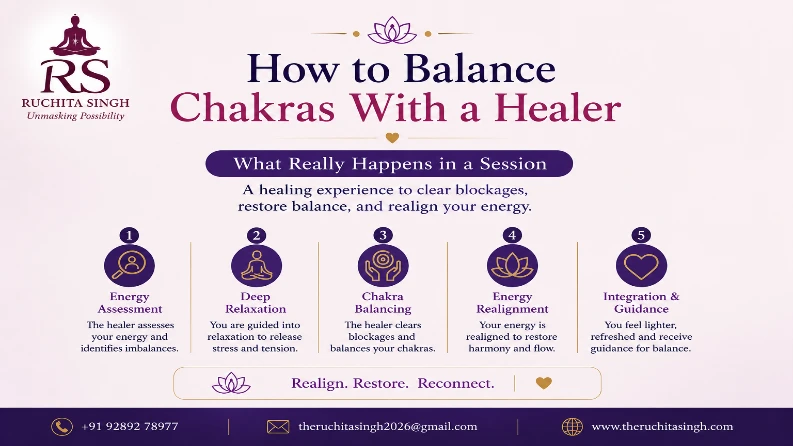
When you arrive at a chakra healing session with Ruchita Singh — whether by phone or video — the session unfolds in three distinct phases: assessment, clearing and balancing, and sealing.
Phase 1 — Assessment
The session begins with a structured conversation about your current physical, emotional, and life-situation state. Ruchita uses this, alongside her energetic assessment of the chakra system, to identify which chakras are most significantly imbalanced and in which direction — underactive or overactive.
Common signals she looks for include: areas of chronic physical tension or pain, recurring emotional patterns (anger, sadness, fear, shutdown), life areas that feel consistently stuck, and the client’s own sense of where something feels ‘off.’
Phase 2 — Clearing and Balancing
The main body of the session involves working with the identified imbalances. Techniques used include breathwork directed to specific energy centres, guided visualisation that uses light and colour (each chakra is associated with a specific frequency of colour), sound healing using tonal frequencies, and directed energy work.
Clients often report notable physical sensations during this phase — warmth in specific parts of the body, a feeling of release or movement, sometimes emotional expression. These are signs of the energy system beginning to shift.
Phase 3 — Sealing and Grounding
After the clearing work, the session ends with grounding — bringing the client’s awareness back into the physical body and establishing a sense of stability and safety. This phase is important because energy work without grounding can leave a person feeling spacey or emotionally unsettled.
The Seven Chakras — What Each One Governs
Understanding the seven chakras helps you identify which areas of your life a healer will focus on and why:
- Root Chakra (Muladhara) — Red: Safety, financial security, physical health, feeling grounded and stable. Located at the base of the spine.
- Sacral Chakra (Svadhisthana) — Orange: Creativity, sexuality, pleasure, emotional fluidity. Located below the navel.
- Solar Plexus Chakra (Manipura) — Yellow: Personal power, confidence, self-esteem, willpower. Located at the stomach area.
- Heart Chakra (Anahata) — Green: Love, compassion, connection, forgiveness, emotional openness. Located at the centre of the chest.
- Throat Chakra (Vishuddha) — Blue: Communication, honest expression, speaking truth, creative voice. Located at the throat.
- Third Eye Chakra (Ajna) — Indigo: Intuition, mental clarity, insight, inner knowing. Located between the eyebrows.
- Crown Chakra (Sahasrara) — Violet/White: Spiritual connection, consciousness, purpose, inner peace. Located at the top of the head.
Chakra Meditation Classes — Learning to Balance Your Own Energy
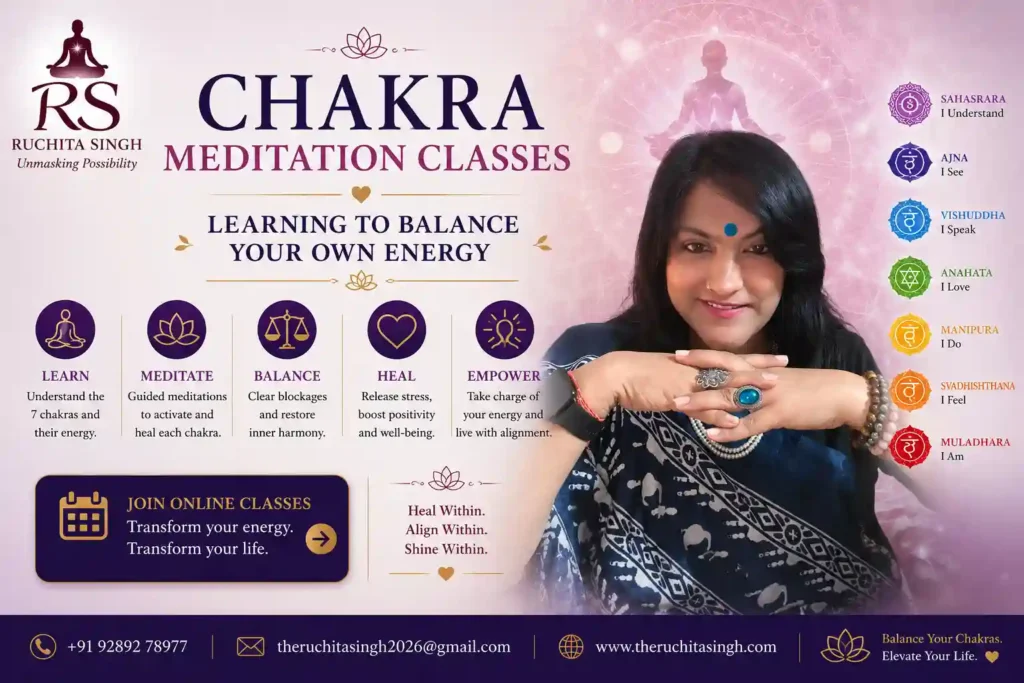
Beyond one-on-one healing sessions, Ruchita Singh also offers chakra meditation classes for those who want to develop the ability to work with their own chakra system independently. These classes are particularly valuable as a complement to healing sessions — giving you tools to maintain the balance achieved in sessions and continue deepening your own energy awareness.
The chakra meditation classes online cover a structured series of practices — one for each chakra — building from root to crown over the course of the programme. Each class covers the specific meditation technique for that chakra, the physical and emotional signs of imbalance, the affirmations associated with each energy centre, and how to use breath and visualisation to work with it daily.
Students who combine one-on-one healing sessions with independent chakra meditation practice typically progress significantly faster than those who attend sessions alone. The healer addresses deep blockages; the daily practice maintains the open state and builds long-term resilience.
Signs That Your Chakra Balancing Work Is Having an Effect
Chakra healing is not always immediately dramatic. For some people, a single session produces a noticeable shift — they sleep better, feel calmer, or experience an emotional release they have been carrying for a long time. For others, the changes are subtler and accumulate over multiple sessions.
Common signs that chakra balancing is working include:
- A feeling of physical lightness or ease after a session
- Improved sleep, particularly dreams becoming more vivid or peaceful
- A greater sense of emotional stability — reactions becoming more proportionate
- Old patterns (avoidance, reactivity, persistent fear) beginning to feel less automatic
- A renewed sense of clarity about decisions or situations that had felt stuck
- Increased energy or a return of enjoyment in things that had felt flat
Do You Need a Healer, or Can You Do It Yourself?
Both have a role, and the most effective approach for most people is a combination of the two. A trained healer brings the ability to identify imbalances you may not be aware of, work with the energy body in ways that require skill and training, and provide the kind of clear external perspective that is very difficult to generate for yourself.
Self-practice through chakra meditation classes builds your own ongoing capacity — the ability to maintain balance, notice when a chakra is beginning to close down, and address it before it becomes a significant blockage.
Think of it like physical health: you might see a physiotherapist for a specific injury (the healer role), and you also practise yoga or exercise daily to maintain your body’s strength and flexibility (the self-practice role). Both are necessary; neither fully replaces the other.
Ready to Begin Chakra Healing?
Whether you are looking for a one-on-one session to address a specific imbalance, a longer healing series to clear deep-rooted patterns, or chakra meditation classes to develop your own daily practice — Ruchita Singh’s online sessions are available across India and designed to meet you wherever you are starting from.
Frequently Asked Questions
How many chakra healing sessions do I need?
This depends on how long the imbalances have been present and how much self-practice you do between sessions. Many clients notice significant shifts within 2–3 sessions. For long-standing or deep-rooted imbalances, a series of 6–8 sessions combined with daily chakra meditation practice tends to produce lasting results.
Is chakra healing a religious practice?
No. The chakra system originates from the Yogic and Ayurvedic traditions of India and is a framework for understanding the energy body — not a religious practice. It does not require any specific belief system. Many clients from diverse religious and non-religious backgrounds find it beneficial.
Can chakra healing help with physical health issues?
Chakra healing addresses the energy body, which the Yogic tradition understands as underlying the physical body. Many clients report improvement in stress-related physical symptoms — tension, headaches, digestive issues, sleep problems — following chakra balancing. It is used as a complementary practice alongside conventional medical care, not as a replacement for it.
What is the difference between a chakra healing session with a healer and doing chakra meditation on my own?
A chakra healing session with a trained healer provides an external energetic assessment — identifying which chakras are imbalanced and in which direction, then using specific techniques including breathwork, sound, and directed energy work to address those imbalances. This addresses deep blockages that are very difficult to reach through self-directed practice alone. Chakra meditation classes you practise independently build your ongoing capacity to maintain balance and develop sensitivity to your own energy system. The most effective long-term approach combines both: healer sessions to clear and reset, self-practice to maintain and build.
How do I know which of my chakras is blocked, and what are the signs for each one?
Each chakra governs a specific area of life and body, and its blockages show up in recognisable patterns. Root chakra blockage shows as financial anxiety, feeling unsafe, or lower back pain. Sacral blockage as emotional numbness, blocked creativity, or reproductive issues. Solar plexus blockage as low confidence and digestive problems. Heart chakra blockage as difficulty trusting others, guardedness, or persistent grief. Throat chakra blockage as difficulty expressing honestly or fear of conflict. Third eye blockage as mental fog, poor intuition, or difficulty making decisions. Crown chakra blockage as feeling disconnected from purpose or a persistent sense of meaninglessness. Ruchita Singh’s sessions include a full chakra assessment as part of the initial session.
Chakra healing session near me India online?
Ruchita Singh offers online chakra healing sessions accessible from anywhere in India — no physical attendance required. Sessions are conducted by video call or phone. Clients from Delhi, Mumbai, Bangalore, Hyderabad, Pune, Chennai, and cities across India attend regularly.
Best chakra meditation classes online India?
Ruchita Singh’s chakra meditation classes online are available for students across India. The programme covers all 7 chakras with dedicated practices, affirmations, and breathwork techniques for each energy centre. Classes are conducted online and available in flexible formats.